Oedipa’s Discovery of the Inverarity Connection
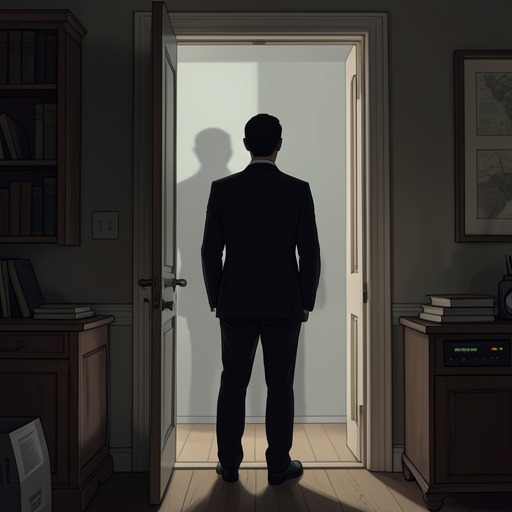
The Crying of Lot 49Oedipa’s Discovery of the Inverarity Connection occurs when the clues she has assembled about Tristero lead back, one by one, to Pierce Inverarity’s estate. A newly surfaced stamp and its catalogue entry appear to confirm a historical San Francisco postal service, yet the places and people connected to that evidence are also tied to Inverarity. The discovery does not resolve the mystery. Instead, it makes the estate a possible source of the network itself, or of an elaborate fabrication, leaving Oedipa to confront several explanations that she cannot distinguish.
The Stamp and the Catalogue
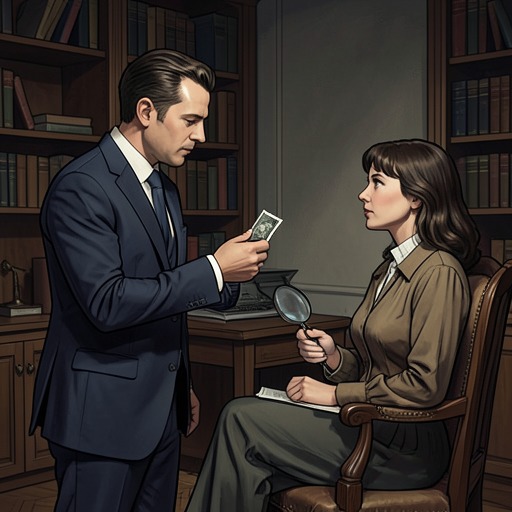
The connection sharpens when Genghis Cohen calls Oedipa to see an old American stamp bearing the muted post horn, a badger, and the motto “WE AWAIT SILENT TRISTERO’S EMPIRE.” Cohen says a friend in San Francisco supplied it. The friend could not find the stamp in the catalogue, but Cohen has located an addendum pasted into a battered Scott catalogue: it identifies the design as “Tristero Rapid Post, San Francisco, California,” numbered 163L1 and positioned among the local American listings. The catalogue’s end-paper carries a sticker from Zapf’s Used Books, a detail that sends Oedipa from the stamp toward the estate’s property records.
The stamp is suggestive but not conclusive. Oedipa recognizes that anyone could have pasted an addendum into a catalogue. Its existence therefore supports two readings at once: a private postal service may have left an obscure, documented trace, or someone may have manufactured the trace to make the service seem real. Cohen’s account adds a further complication: he had visited Metzger while Oedipa was away, and the catalogue belongs to a field he does not usually maintain. The chain of custody is not transparent, even as the stamp’s motto gives the hidden network an apparently explicit name.
Following the Estate’s Property
Oedipa returns to San Narciso and checks Inverarity’s list of assets. The shopping center that houses Zapf’s Used Books and Tremaine’s surplus store belonged to him; the Tank Theatre did as well. The finding expands beyond a single questionable book entry. Locations already associated with her investigation stand within the deceased businessman’s property network, making his estate a recurring point of access to the Tristero clues.
She then extends the pattern from places to people. Emory Bortz teaches at San Narciso College, which Inverarity heavily endowed. Oedipa considers whether Bortz, Metzger, Cohen, Driblette, Koteks, the tattooed sailor in San Francisco, and the W.A.S.T.E. carriers she followed might all be Inverarity’s agents. The evidence does not establish that they were bought, recruited, or even coordinated. Oedipa’s suspicion is a question produced by the pattern, not an answer to it; she imagines both deliberate payment and voluntary participation in a practical joke.
Earlier Clues Recast by the Discovery
The estate connection changes the force of clues that had seemed to arise from independent encounters. In a bar restroom, Oedipa found an invitation to contact Kirby through WASTE, along with an unfamiliar symbol, and copied the address and mark into her notebook. At Yoyodyne she approached Stanley Koteks by saying that Kirby had sent her; the encounter made the name on the restroom notice seem to lead into a wider communication system. Later, Cohen showed her the WASTE symbol as a watermark on a canceled 1940 Pony Express commemorative stamp. These repetitions connect a handwritten notice, a company employee, and a philatelic object, but the new estate evidence raises the possibility that the apparent links were planted or staged.
Other episodes supply context for why the network initially seemed historically plausible. Mike Fallopian was researching private mail delivery in the United States and saw the federal suppression of independent routes around the Civil War as part of a longer history of postal power. Oedipa had also encountered a marker at Fangoso Lagoons describing the 1853 killing of Wells, Fargo men by masked marauders, with a victim’s mark in the dust that could be read as a cross or a T. At another point, an anonymous member of Inamorati Anonymous described how a founder discovered the muted post horn on a stamp after gasoline dissolved its printing ink, and said the sign became the group’s emblem. Such details place the post horn and competing postal systems in a dispersed historical and social field. They do not independently verify the claim that every present-day clue belongs to one organization—or that the estate has arranged them.
Four Explanations, No Resolution
Oedipa formulates four symmetrical possibilities. She may have encountered a genuinely secret network through which Americans communicate outside official delivery channels; she may be hallucinating that hidden structure; a costly plot may have been built around her, using forged stamps, old books, surveillance, planted post horns, bribed librarians, and professional actors, with financing concealed in the estate; or she may be inventing that plot and be mentally unwell. The estate’s connection makes the conspiracy hypothesis more imaginable because Inverarity’s resources could account for its scale, but it cannot prove that he commissioned anything. The same pattern that lends the theory coherence also makes it impossible for Oedipa to treat any single confirmation as independent.
The discovery leaves her hoping that mental illness is the simplest explanation, even as she cannot secure that conclusion. She sits for hours feeling that nobody can help and that the people around her may be involved, ill, or dead. The investigation’s central problem is thus no longer only whether Tristero exists. It is whether evidence that repeatedly leads back to one wealthy dead man can distinguish a real clandestine network from a designed deception—or from Oedipa’s own interpretation of coincidences. The connection provides a new organizing pattern, but no reliable way to test it.